What a Trade Really Costs
 Video coming soon on YouTube
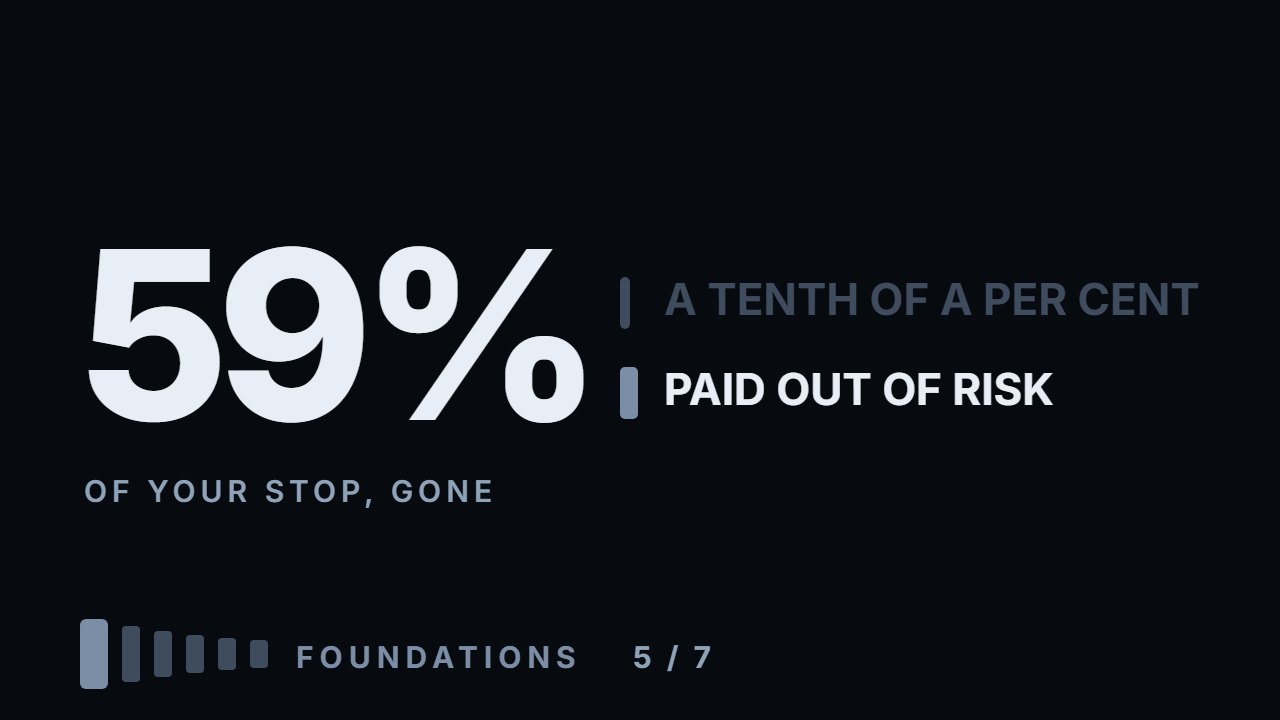
Costs are quoted as a percentage of the amount you traded. They are paid out of your stop. Until you make that conversion, a tenth of a per cent looks like nothing.
Made on one instrument it is a rounding error; made on another it eats more than half the risk before price has moved at all. The difference is not the venue being greedy — it is a percentage fee meeting a stop measured in the instrument's own movement. Everything here is measured: the calculation ships with the video.
What to do with this
Take your instrument. Average the last twenty daily ranges and take a tenth as your stop. Then find your venue's actual fee, both sides, add the spread, and divide by that stop. Under five per cent, carry on. Over a third, the entry method has to change before anything else does.
Chapters
- 0:00Two traders, same plan, two markets
- 1:01The three of them
- 1:29Two ways a venue charges
- 2:35Taken from the amount, paid out of the stop
- 3:07The only honest way to measure a cost
- 3:21On a stock
- 4:18The same trade on Bitcoin
- 4:48Fifty nine per cent of the stop
- 5:19And that is the good tariff
- 5:49Larger than what you were willing to lose
- 6:00Through the expectancy line
- 6:38What a year of it costs
- 6:55Why it never shows up in your results
- 7:41The lever people reach for, and why it is the wrong one
- 8:17The discount hiding in the order type
- 9:03Three honest responses
- 9:48Two honest limits
- 10:24Go and do this
The calculation
Every number this lesson says out loud comes from the script below. results.txt is what it printed when the video was made.
Full transcript
Two traders take the same trade. Same rule for the stop, same target at three times it, same discipline. One of them is trading a stock. The other is trading Bitcoin. Over two hundred trades the first one keeps almost everything the system earned. The second one gives back more than half of it, and never sees where it went.
Nothing about their skill was different. What differed was a number neither of them wrote down before entering, because it does not appear on the chart and it does not appear in the profit and loss of any single trade.
By the end of this you will be able to work out, before you place anything, what one round trip costs you in that instrument. Not in dollars, and not as a percentage of the money you moved. As a fraction of your own stop. That is the only form of the number that tells you anything.
There are three of them, and they are usually described as small. The spread. The commission. And slippage.
The spread is the gap between the price you can buy at and the price you can sell at, at the same moment. Cross it once to get in, and once to get out. Nobody charges it to you as a line item. It is simply the price of being on the wrong side of both quotes.
The commission is what the venue takes for matching you. And here is the first thing that matters, because the two markets do it differently, and almost nobody notices.
A stock broker usually charges per share. Half a cent per share, or a cent per share — a fixed amount, so the cheaper the share, the bigger the slice of its price: at ten dollars, a hundred times bigger than at a thousand.
A crypto exchange charges a percentage of the amount. A tenth of a per cent, a quarter, four tenths — of whatever the position was worth. Against the price, that is the large one. Half a cent on a three hundred dollar share is about a sixtieth of a tenth of a per cent.
Slippage is the third, and it was the whole subject of the video on order types. Worth one sentence here: it is not a fee, only part of it runs both ways, and on a liquid instrument in a quiet moment it is the smallest of the three.
Now the sentence that makes the arithmetic work. All three are taken out of the amount you traded. All three are paid out of your stop.
Sit with that, because it is the whole video. Your risk on a trade is the stop distance times the number of units. Your cost is the fee times the same number of units. The units cancel. What is left is a ratio that does not care how big your position was.
Which means there is one honest way to measure a cost, and it is not the percentage the venue quotes you. It is this: what fraction of my stop does one round trip eat?
Work it on a stock. Apple, average daily range over the last twenty sessions, six dollars and fifty one cents. For the stop, take a tenth of that: sixty five cents. Why a tenth comes later, in the risk module — this arithmetic works with any stop.
Half a cent per share each way is one cent. A cent of spread is another. Two cents, round trip, against a stop of sixty five cents. Three per cent of the risk.
Tesla, same arithmetic, moves more: a stop of one dollar and twenty four cents. The same two cents is one point six per cent. On these instruments the cost is a rounding error you should still know, and that is the honest description of it.
Now the same trade on Bitcoin. Price around seventy nine thousand eight hundred. Average daily range two thousand eight hundred and forty three. A tenth of that is a stop of two hundred and eighty four dollars.
A tenth of a per cent each way, on seventy nine thousand eight hundred, is about eighty dollars a side. Round trip, with spread, a hundred and sixty seven. Against a stop of two hundred and eighty four.
Fifty nine per cent. The same discipline, the same rule for the stop, the same target — and the trade starts more than half a stop underwater before price has moved at all.
Ethereum on the same tariff: forty three per cent. Solana: thirty five. The pattern is not about which coin. It is about a percentage fee meeting a stop measured in the instrument's own movement.
And that is the case where the tariff is good. Exchanges charge more at low volume — four tenths of a per cent a side is a real published number, not an invented one.
At four tenths, Bitcoin costs six hundred and forty seven dollars round trip against a stop of two hundred and eighty four. Two hundred and twenty seven per cent. Ethereum, a hundred and sixty six. Solana, a hundred and thirty six.
Read that plainly. The cost of entering and leaving is larger than the amount you were willing to lose. The trade is decided before the chart does anything.
Put it through the expectancy line from the win-rate video, because that is where it lands. At a target of three stops and no costs, you break even at twenty five per cent of trades going your way: a win pays three stops, a loss costs one, so one win in four keeps you level.
On the stock, that becomes twenty five point eight. On Bitcoin at a tenth of a per cent, thirty nine point seven. At four tenths, eighty two. The rule did not change. The arithmetic under it did.
Over two hundred trades in a year, the stock costs you six R. The Bitcoin trade at a tenth of a per cent costs a hundred and eighteen. At four tenths, four hundred and fifty five.
And here is why none of this shows up when you look at your results. The fee is taken out of each trade before you ever see the number. A loss comes back slightly larger, a win slightly smaller, and neither looks wrong. Nothing in the statement says: this is what the venue took this year.
Costs also do not care whether you were right. The winner pays the same round trip as the loser. So they hit the expectancy line from both sides at once — the average win gets smaller and the average loss gets larger, and those are exactly the two numbers the win-rate video says decide everything.
Which points at a lever people reach for, and it is the wrong one. The cost per trade is fixed by the venue; the cost per year grows with how many trades there are — and so does whatever the system earns.
Four setups a week is two hundred trades a year. Four a day is a thousand. Same instrument, same tariff, same rule — five times the toll, and five times the result. Frequency changes the size of the result, not its sign.
Now the part that is actually actionable, because there is a discount hiding in the order type. Most venues charge two different fees: one for taking a price that is already there, and a lower one for leaving an order and waiting.
Which is the same distinction as the market order and the limit order. Taking costs more. Waiting costs less, and sometimes nothing at all. On the tariffs used here, that difference alone can halve the number.
So the entry method and the cost of the trade are the same decision, seen twice. That is worth knowing before you decide to enter at market because it feels decisive.
Three honest responses when the number comes out high, and you will recognise their shape. Enter with orders that wait, so you pay the lower fee. Take a longer stop, so the same cost is a smaller share of it — which means a wider target and a different trade. Or trade something that moves more for its price.
What is not on that list is trading a smaller size. Size does not appear in the ratio at all. It cancelled out in the third minute of this video, and that is precisely why the cost is invisible: it does not get bigger when you get bolder.
Two honest limits. The tariffs here are assumptions, named out loud so you can replace them: half a cent a share, a tenth of a per cent, four tenths. Yours will differ, and volume earns discounts on every venue.
And spreads widen exactly when you most want out. The cost measured in a quiet moment is the floor, not the average — which is the same thing the order types video said about slippage, arriving from a different direction.
So, the thing to go and do. Take your instrument. Average the last twenty daily ranges, take a tenth as your stop. Then find your venue's actual fee, both sides, add the spread, and divide by that stop. Under five per cent, carry on. Over a third, the entry method has to change before anything else does. Educational content only. Nothing here is financial advice.
Educational content only. Nothing in this video is financial advice, a recommendation to buy or sell, or a promise of any result. Trading involves risk of loss. Do your own research. Risk warning.