Market, Limit, Stop - The Only Three Orders You Need
 Video coming soon on YouTube
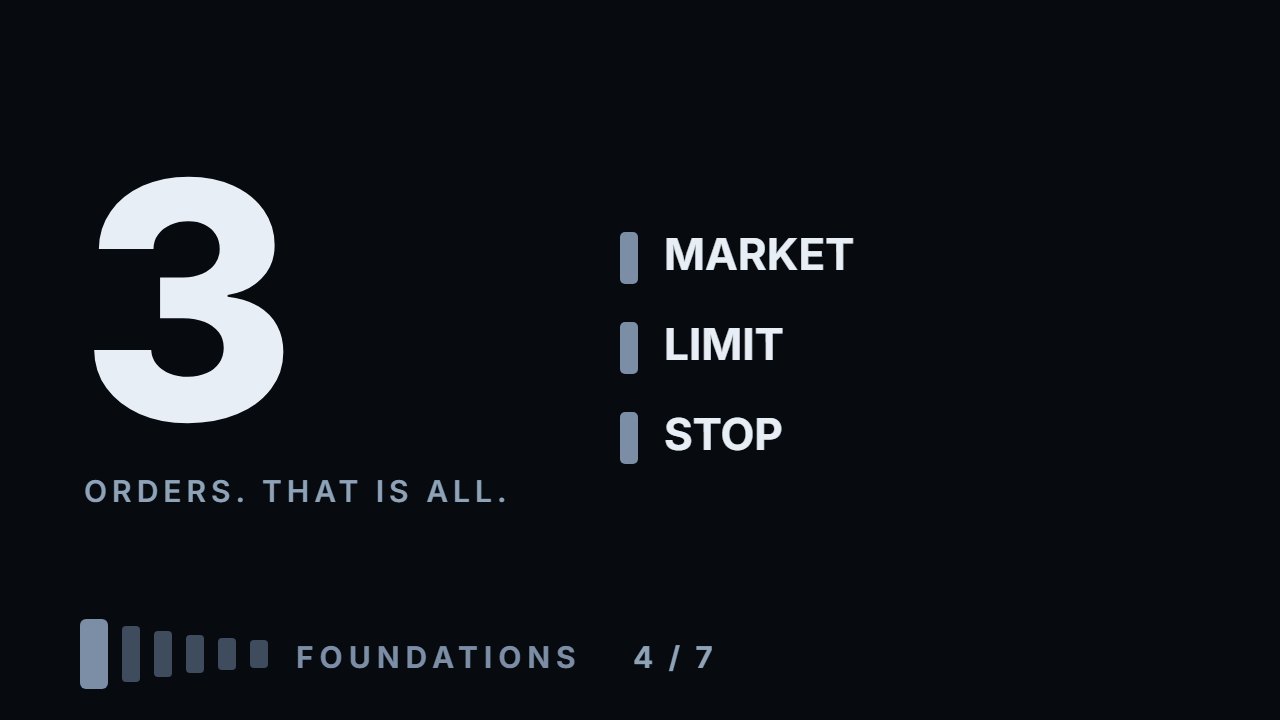
Your platform offers a dozen order types. You need three of them, and two of the three are the same thing wearing different clothes.
Choosing between them is not a technical decision — it is a decision about what you are willing to pay with. And a stop order does not do what most people believe it does.
What to do with this
Place a limit order well away from the market, watch it sit unfilled, and cancel it. Then place a market order for the smallest size your platform allows, and note the price on screen before you send it against the price you actually got. On the most liquid thing you have, in a quiet moment, that difference is your best-case slippage. It is the floor, and now you know it instead of assuming it is zero.
Chapters
- 0:00The wall of order types
- 0:49Market: certainty of execution
- 1:35Slippage, and what it is not
- 2:19Limit: certainty of price
- 2:52Why your limit did not fill
- 4:16A stop is not a third type
- 4:39Two consequences of that
- 5:30Why price finds the stops
- 6:05Stop-limit, and its trap
- 6:43The one question that picks
- 7:14The rule of thumb
- 7:56Two places it reverses
- 8:33The cost nothing itemises
- 9:50Go and do this
Full transcript
Every platform gives you a wall of order types. Market, limit, stop, stop-limit, trailing stop, fill or kill, and a dropdown with six more. You need three of them. The rest are combinations of the three, and two of the three are the same thing wearing different clothes. More usefully: choosing an order type is not a technical decision. It's a decision about what you're willing to pay with.
By the end of this you'll know what each of the three actually does, what it costs, and the one question that picks between them. And you'll know why a stop order does not do what most people believe it does — which is the part that costs beginners real money.
Start with the market order, because it's the simplest and the most misunderstood. A market order says: I'll take whatever price is available right now. And at any moment there are two prices: the bid, the most anyone will pay, and the offer, the least anyone will sell for. A market buy pays the offer, a market sell takes the bid, immediately. What you get is certainty of execution. You will be filled. That is the entire product. What you pay is certainty of price. You don't know what price you'll get until you have it.
That gap between the price you saw and the price you got has a name. Slippage. Two things about it worth getting straight. First, it isn't a fee, and nobody charges it to you. It's just the market moving between your decision and your fill, plus the spread you cross to get in, the distance from the bid to the offer.
Second, only part of it runs both directions. If price is falling as you buy, you may get filled better than the number on the screen. The spread you cross never runs your way. So on average slippage is a cost, even though some fills come out better.
Now the limit order, and it's the mirror image. A limit order says: I'll trade at this price or better, and if that's not available, I'd rather not trade. Certainty of price. No certainty of execution. That is the whole trade-off, and it's why the choice is never about which order is "better". Market buys execution with price. Limit buys price with the risk of not being filled at all.
The unfilled part is not a rare edge case, and this is where beginners get hurt without noticing. You place a limit at the exact price of your level. Price comes down, touches it, and turns. Your order doesn't fill.
Why? Because at that price there was a queue. Other people's limit orders were sitting there before yours, and there was only enough selling to fill the front of it. Price touched your number and left, and you watched the move you predicted without being in it. That isn't bad luck. Touching a price is not the same as trading enough volume at it to reach your place in line.
Which is why people who enter with limits leave a small buffer between the level and the order. You place the buy slightly above the level rather than exactly at it. You accept a marginally worse price in exchange for a much better chance of being filled at all.
There's a real number behind how big that buffer should be, and it comes out of the same calculation as your stop distance. That's the noise-buffer video in the risk module, so I'll leave it there — but know that the buffer is calculated, not guessed.
Now the third one, and here's the sentence that reorganises everything. A stop order is not a third kind of order. It's a market order with a trigger. You are not placing an order to sell at your stop price. You are placing an instruction: when price touches this number, send a market order.
Sit with what that means, because two consequences follow and both matter. First: a stop does not guarantee your price. It guarantees an attempt. When it fires, it becomes a market order, and market orders take whatever is available. If the market is thin or gapping, what's available can be far from your number. And it almost always misses the wrong way: a stop only fires when price is already moving against you.
Second: your stop is not visible to the market as an order. Nothing is resting there. It's a condition held by your broker, which converts into a live order only at the moment it triggers.
And that second point explains the thing everyone finds sinister. If stops aren't resting orders, why does price so often reach exactly the price where stops must be?
Because the level is public. Everyone can see the obvious low, everyone reaches the same conclusion about where they'd be wrong, and everyone places a trigger just past it — separately, without coordinating. The orders aren't visible. The reasoning is. That's enough.
There's a fourth type you'll see, and it's just the two combined. A stop-limit says: when price touches this number, send a limit order instead of a market order. That sounds strictly better and it isn't. You've swapped one risk for another: now your stop can fail to fill.
In a fast move — precisely when you most need out — price can blow through your limit and leave you in a position you thought you had exited. There are legitimate uses. Protecting a position you must exit is not one of them.
So, the question that picks between them, and it's one question. What is more expensive to me right now: a worse price, or no trade at all? If a worse price is cheaper — you must be in, or you must be out — use a market order. If no trade is cheaper — you're placing a considered entry and you'd rather miss it than pay up — use a limit. The rest is detail.
Which gives a rule of thumb that holds up almost everywhere. Getting out when you must is a market order. Getting in, and taking profit at a target, is usually a limit. Forced exits are where "I must" lives. A stop you need to honour, a position you want closed before news, a trade that has invalidated. You are buying certainty of execution and the price is worth it. Entries are where "I'd rather not, then" lives. If you miss it, nothing happened. There is another setup.
Two places this reverses, so you don't apply it blindly. Breakout entries. If the whole idea depends on being in while price is moving, a limit behind the move will simply not fill. That's an entry where you're buying execution on purpose.
And illiquid instruments. If the spread is wide, market orders pay all of it every time you get in and out: you buy at the offer and sell at the bid. On something thin, that one spread can be a meaningful fraction of what the trade was worth.
Which brings the cost that beginners never count, because nothing itemises it. Every market order crosses the spread. Every fill pays commission. On one trade it's invisible. Over two hundred trades it is a line item large enough to move a system from profitable to not.
That is a whole video of its own — what a trade really costs — and it's in this module. For now: the cheapest order type is the one you didn't need to send twice.
One last thing, because it's the most common beginner error and it has nothing to do with theory. Check which direction the order form defaults to. Check the quantity. Check that "market" is selected and not "limit" left over from your last trade.
Sending the wrong type is not rare, and it's not stupidity — the forms are dense and they remember your last settings. The traders who avoid it aren't more careful. They check the same three fields every time, in the same order, until it isn't a decision any more.
So, the thing to go and do, and it costs almost nothing. Open your platform. Place a limit order to buy something liquid, at a price well below the market — somewhere it will not fill. Look at it sitting in the order book, the list of orders waiting to trade. Then cancel it. Now place a market order for the smallest size the platform allows.
Note the price on the screen before you send it, and the price you actually got. That difference, on the most liquid instrument you have, in a quiet moment, is your best case slippage. Whatever that number is, it's the floor. Every market order you send pays at least that on average, and now you know what it is instead of assuming it's zero. Educational content only. Nothing here is financial advice.
Educational content only. Nothing in this video is financial advice, a recommendation to buy or sell, or a promise of any result. Trading involves risk of loss. Do your own research. Risk warning.