Leverage and Margin: How Accounts Blow Up
 Video coming soon on YouTube
Leverage does not multiply your profit. It puts a second stop between you and the market — one you did not choose, cannot move, and that sits at a distance which has nothing to do with your idea.
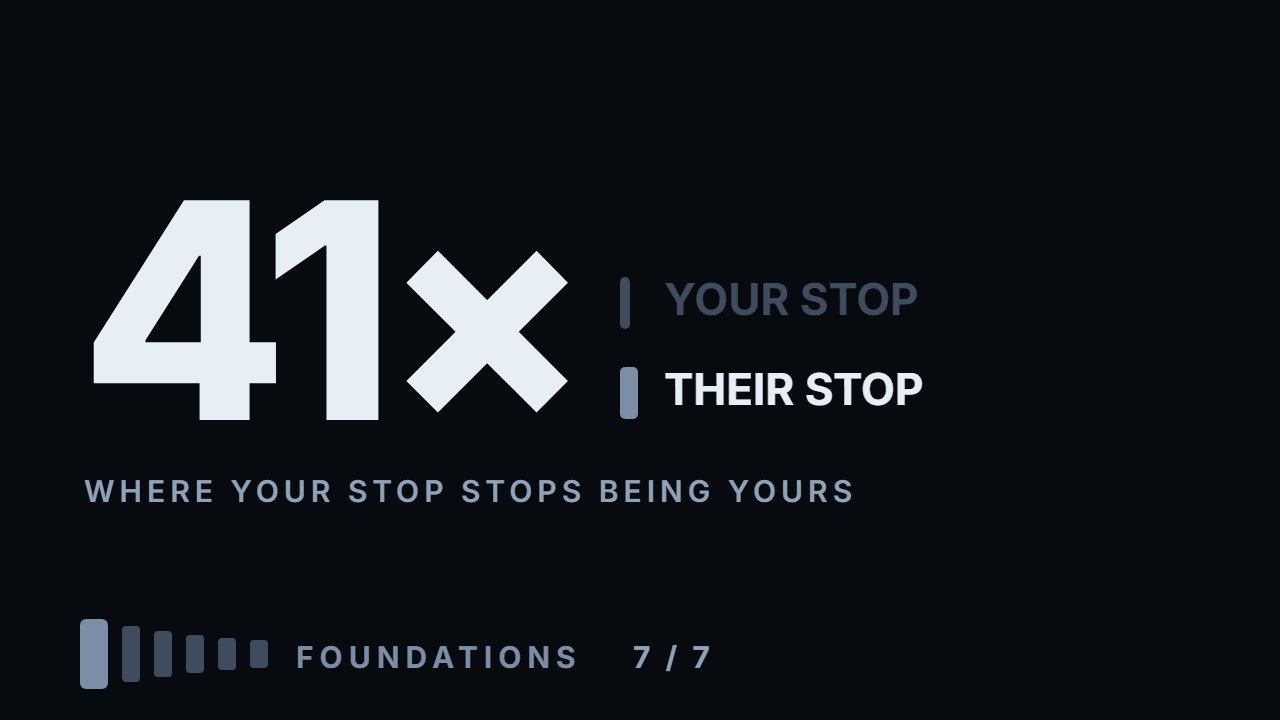
That distance is arithmetic: at 10× you are liquidated 9.5% against you, at 50× it is 1.5%, at 100× half a per cent. On Apple's last year a 1.5% fall from the open happened on 21% of days, and half a per cent on 63%. But the number that actually matters is the crossing point — the leverage at which liquidation becomes closer than your own stop. On Apple with a stop of one typical daily range that is 41×; on Solana it is 19×. Below it, leverage changes nothing at all: the same 248 trades on Apple, risk fixed at 1% of the account, ended the year exactly the same at 2×, 5×, 10× and 20× — to the decimal. Above it the exchange decides instead of you: at 50× more than half the trades were liquidated before reaching the stop or the target, and most of the year's result was gone. Everything here is measured: the calculation ships with the video.
What to do with this
Take the instrument you trade, on isolated margin. Work out your usual stop as a percentage of price, add half a per cent for the exchange's buffer, divide one by that number and round down. That is the leverage at which the exchange takes the decision away from you. Write it on the same page as your position size — they are the same conversation.
Chapters
- 0:00Leverage puts a second stop in your trade
- 0:41The mechanism: whose money is first in line
- 1:39The whole table of liquidation distances
- 2:25How often price travels that far
- 3:27What it looks like as time
- 4:03The number this video exists for
- 4:39The crossing point, and how to calculate it
- 5:34The measurement: same trade, only leverage changed
- 6:46Where it stops being identical
- 7:17Solana, and the least intuitive number here
- 8:00Why a liquidation cost more than the stop
- 8:59The cost everybody forgets
- 9:41Four honest limits
- 11:04Go and do this
The calculation
Every number this lesson says out loud comes from the script below. results.txt is what it printed when the video was made.
Full transcript
Here is a claim you have heard, and it survives measurement badly. Leverage multiplies your profit and your loss. The second half is closer than the first, and both of them hide what leverage actually does.
What it does is put a second stop between you and the market. You did not choose it, you cannot move it, and it sits at a distance that has nothing to do with your idea.
By the end of this you will know exactly where that second stop sits at any leverage, at what point it becomes closer than your own, and what happened to the same trade when only the leverage was changed.
Start with the mechanism, because it is arithmetic and not opinion.
You put up part of the money and borrow the rest. At ten times leverage, one tenth of the position is yours. The other nine tenths belong to whoever lent it. Your tenth is called the margin.
The lender's money is not at risk. Yours is first in line. So when the loss eats through your share, the position is closed — not by you, and not at a price you chose.
Which gives the distance. At ten times, your share is ten per cent of the position, so a ten per cent move against you wipes it out.
Slightly less, in fact, because the exchange closes you before it reaches zero. Call that buffer, the maintenance margin, half a per cent, and the number becomes nine and a half.
Here is the whole table, and it is the same on any instrument, because it is not about the instrument.
Two times: you are liquidated at forty nine and a half per cent against you. Three times: thirty three. Five times: nineteen and a half.
Ten times: nine and a half. Twenty times: four and a half. Fifty times: one and a half. A hundred times: half a per cent.
Notice what happened between the last two rows. Going from fifty to a hundred did not double your risk. It cut the room you have to a third — from one and a half per cent to half of one.
Now bring in the market, because a distance means nothing until you know how often price travels it.
Take every day of the last year and ask how far price fell from the open before it recovered — the worst point of each day.
On Apple, a four and a half per cent fall from the open happened on eight tenths of one per cent of days. That is twenty times leverage, gone, on two days out of two hundred and fifty.
At fifty times the distance is one and a half per cent, and Apple did that on twenty one per cent of days. One day in five.
At a hundred times: sixty three per cent of days. Two days out of three.
On Solana the same table reads worse, because a typical Solana day is bigger. Twenty times: nineteen per cent of days. Fifty times: sixty two.
Turn it into time, which is the form people actually feel.
At twenty times on Solana, half of all positions held without a stop are gone within five days. At fifty times, within one.
On Apple at fifty times, four days. At a hundred, within one.
That is the picture people mean when they say leverage is dangerous. It is correct, but it is not the useful part, because it describes holding without a stop — and you were not going to do that.
So here is the useful part, and it is the number this whole video exists for.
If you already use a stop, leverage does nothing at all — until the liquidation distance becomes shorter than your stop.
Before that point, the exchange never gets to act. Your stop is closer, it fires first, and your loss is what you planned, plus whatever a gap adds. The leverage was irrelevant.
After that point, the exchange acts first, every time. Your stop becomes decoration.
And the crossing point is a calculation you can do in ten seconds. Divide one by your stop distance plus the buffer, and round down.
On Apple, with a stop of one typical day — one point nine per cent — the crossing point is forty one times. With a stop of a tenth of a day, it is a hundred and forty four.
With a one-day stop: on Tesla, twenty five. On Bitcoin, twenty eight. On Ethereum, twenty one. On Solana, nineteen.
On a broad index fund, seventy four, because it barely moves. The calmer the instrument, the higher its crossing point.
So the honest version of the rule is not don't use leverage. It is: know where your crossing point is, and stay on the near side of it.
Now the measurement, because everything so far was arithmetic and frequency. This is the same trade, run on real data, with only the leverage changed.
Entry at the open, stop at one typical daily range, target at two, held up to five days. Risk on every trade is one per cent of the account. On ten thousand dollars, with Apple's stop of one point nine per cent, that is a position of about five thousand two hundred, at any leverage. Leverage only decides how much of it is your margin.
Two hundred and forty eight trades on Apple, long only, before costs. Without leverage, the year ends up fifty seven point eight per cent.
At two times: fifty seven point eight. At five times: fifty seven point eight. At ten and at twenty: fifty seven point eight.
Identical. Not similar — identical, to the decimal, because nothing in the trade changed. Leverage never entered the arithmetic.
At fifty times, it enters. Fifty six per cent of the trades are now liquidated before they reach either the stop or the target, and the year ends up eight instead of fifty seven point eight.
At a hundred times, eighty one per cent of trades are liquidated, and the year ends down thirty.
Same entries. Same stop. Same target. Eighty eight percentage points of the result removed by a setting.
Now Solana, and this one is more instructive because it is a down year.
Without leverage the same system ends the year down thirty one per cent. At two, five and ten times: also down thirty one. Identical again.
At twenty times, fifty five per cent of trades are liquidated, and the result is down forty eight. At a hundred times, ninety three per cent are liquidated, and the result is down thirty one — about where it ended without leverage.
Read that carefully. On a falling market, leverage did not cushion anything. Twenty times made the year seventeen points worse.
Here is why. At twenty times a liquidation takes the whole margin — five per cent of the position. The stop it replaced cost four point seven. The liquidation came first and cost more.
And at a hundred times, where the year ended about where no leverage did, look at how it got there.
At ninety three per cent liquidated, the outcome no longer has anything to do with your entries, your stop or your target. Almost every trade ended the same way, at the same fixed distance.
That is not a strategy performing. That is a strategy that no longer exists, replaced by a coin flip on a very short fuse. On the Apple year it took eighty eight points off. On the Solana year it took up to seventeen, and at best it changed nothing.
One more cost, and it is the one people forget entirely.
Commission is charged on the position, not on your capital. At one tenth of a per cent per side, a round trip costs zero point two per cent of the position. Sized from the stop, the position does not change with leverage, and neither does the commission.
It changes when leverage is used to make the position bigger. Put the whole account up at ten times, and a round trip costs two per cent of it. At fifty, ten. At a hundred, twenty per cent of your account, before the market has done anything at all.
Four honest limits. This is one year and six instruments, and the buffer is a typical value — every venue sets its own, and you should read yours. The test also pays no commission and fills every stop at its price: at a tenth of a per cent a side, the Apple year is thirty two, not fifty eight, and with gaps filled at the open as well, twenty three — at every leverage alike. And on a single stock, a regulated broker gives you two to five times; Apple at fifty and a hundred is the arithmetic, not an offer.
And this is isolated margin: each position has its own margin, and a liquidation can take only that. Many venues default to cross margin, where your whole balance stands behind every position, and a liquidation can take the balance. Leverage this high on crypto comes from perpetual futures, where longs and shorts swap a payment every few hours, called funding — sometimes you pay it, sometimes you receive it — and which firms are not allowed to sell to retail customers in the UK.
So, what to go and do. It takes five minutes and it is the only leverage calculation worth memorising.
Take the instrument you trade, on isolated margin. Work out your usual stop as a percentage of price. Add half a per cent for the buffer. Divide a hundred by that number, and round down. On Apple, a hundred divided by two point four is forty one.
That is the highest leverage at which your own stop still decides. Write it on the same page as your position size, because they are the same conversation.
Leverage does not make a good trade better. It sets a deadline on it. Educational content only. Nothing here is financial advice.
Educational content only. Nothing in this video is financial advice, a recommendation to buy or sell, or a promise of any result. Trading involves risk of loss. Do your own research. Risk warning.