Where the Stop Goes - One Question Decides It
 Video coming soon on YouTube
Your stop got hit, and then price went exactly where you thought it would. The usual explanation is that the stop was too tight. It wasn't — it was answering the wrong question.
There is one question that decides where a stop goes, and it produces an order of operations that most people run backwards. That's the part that costs money.
What to do with this
Take your last twenty trades. For each one, write down two prices: where your stop actually was, and where the idea would have been genuinely disproved. Then count the trades where price hit the first number and never reached the second. Those are the trades you were stopped out of while you were still right — at a price you chose, for a reason that had nothing to do with the market.
Chapters
- 0:00Stopped out, and then right
- 0:51"Below the level" is not an instruction
- 1:29Why a fixed percentage is worse
- 2:09A stop does two jobs, not one
- 2:44The question
- 3:13Worked on a level trade
- 4:48The order most people run backwards
- 5:36A stop is never too big
- 6:17What you cannot do
- 7:20What it costs, in numbers
- 8:04When invalidation sits close
- 9:37Where this stops working
- 10:14What to do tonight
Full transcript
Your stop got hit. Then price turned around and went exactly where you thought it would. The explanation everyone reaches for is that the stop was too tight. So next time it goes wider, and the loss is bigger, and the trade after that gets stopped anyway. The stop wasn't too tight. It was in the wrong place, and it was in the wrong place because it was answering the wrong question.
By the end of this you'll have one question that decides where the stop goes. Not a percentage, not a rule of thumb, not a feeling about how much room to give it. And it produces an order of operations that most people run backwards, which is the part that actually costs money.
Start with the two answers you'll hear most often, because both of them sound reasonable. The first is: put it below the level. Below the level by how much? A tick is the smallest step a price can move. Two ticks? Twenty? The instruction doesn't say, which means it isn't an instruction. It's a direction.
And it quietly makes your risk a function of where you happened to draw a line. Draw it three ticks lower and your loss changes, while nothing about the market changed at all.
The second answer is a fixed size. Two tenths of a percent of the instrument price. Fifty dollars. One percent of the account. This one is worse, because it's precise, and precision reads as rigor.
A fixed stop answers the question: how much am I willing to lose on this trade? That's a real question. It's just not this one. It's about your account, and the price where your idea breaks is about the market. Two different subjects, and no reason at all why the answer to one should land at the answer to the other.
Here's the distinction that does the work. A stop does two jobs, and almost everyone collapses them into one. Job one: mark the price at which the reason you took this trade is no longer true. Job two: make sure that being wrong costs an acceptable amount. They are not the same job, they are not answered by the same information, and the order you do them in decides whether the system works.
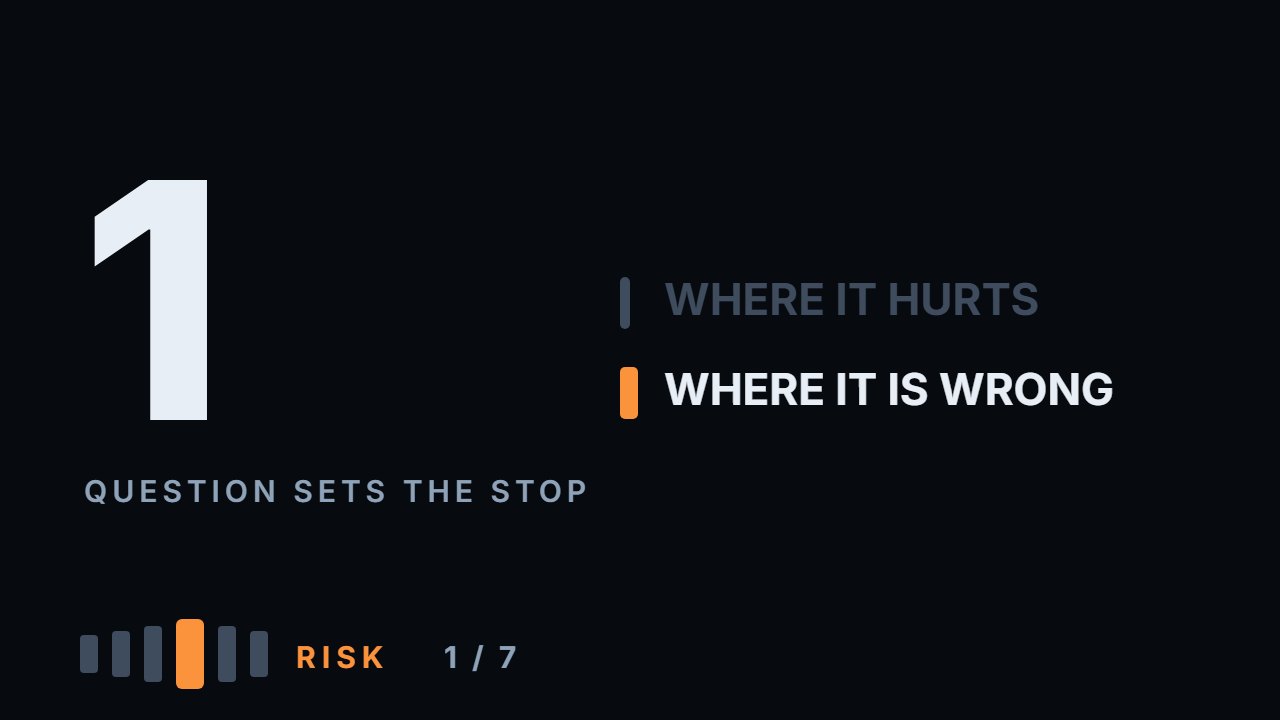
So here's the question. One question, and it's the whole video. At what price is the reason I took this trade no longer true? Not: where does it hurt. Not: where can I afford to be. Where is the idea wrong. Everything else — size, risk, whether to take the trade at all — comes after that price, and comes out of it.
Work it on a level trade, because that's the case in front of most people. You're short from a level: you've sold, and you make money if price falls. Why? Because at that price, sellers have shown up before. That's the entire reason. Position memory, resting orders, the fact that everyone can see it — whatever the mechanism, the claim is: sellers defend this price. So when is that claim false?
Not when price touches the level. Not when it pokes through by a tick. It's false when price trades and holds above it with conviction, because that is exactly what sellers failing to defend it looks like. That price — the one where holding above means sellers lost — is your stop. It was determined by the market before you ever thought about your account.
Which immediately raises: how far above? Poking through by one tick isn't sellers failing. It's noise. There's a real number there, and it isn't a feeling. Every instrument has a scale of movement that means nothing, and the stop belongs outside that band, not inside it. Calculating it is its own video, and it's the next one in this module. For now, what matters is the shape of the answer: the distance comes from the instrument's own noise, not from your account.
Now the part that runs backwards for most people. The usual order is: decide the position size, then find a stop that fits it. That's how you end up with a stop three ticks from entry on a trade that needs twenty. The correct order is the reverse, and it only has three steps.
First: find the invalidation price. That comes from the market. Second: the distance from your entry to that price is your stop. You don't choose it. You read it. Third: size is whatever makes that distance cost an acceptable amount. Size is the free variable. It is the only free variable.
Which means a stop is never too big. That sentence sounds wrong, so sit with it. If the invalidation price is far away, that's not a problem with the stop. It's the market telling you this trade is expensive. You have three honest responses, and you'll notice what isn't among them.
You can size down until the cost is acceptable. You can skip the trade, because at a sane size it isn't worth taking. Or you can find an entry closer to the invalidation price, which is a different trade with a different setup.
What you cannot do is move the stop closer to make the size work. Look at what that actually produces. This time you've bought, so the stop sits below. You now hold a position with a stop that sits at a price where your idea is still true. Which means the most likely way this ends is that you get taken out while you were right, and price goes on to do the thing you predicted. That is not bad luck. You built it on purpose. You chose a stop that triggers before your thesis is disproved.
The reason this is hard is that a tight stop feels like discipline. It's smaller. It sounds professional. You can tell yourself you're managing risk. And the feedback is delayed and disguised: the loss is small, so it doesn't hurt enough to investigate, and the trade that would have worked never shows up in your account as a loss. It shows up as nothing at all.
But it does show up, and the win-rate video is where you can see it. Moving a stop closer lowers your win rate, it doesn't raise it, and this is the part worth being precise about. A stop inside the noise gets hit more often, so the win rate falls, and the average loss falls with it because each loss is small.
Run those two through the expectancy line: win rate times average win, minus loss rate times average loss. When the win rate falls faster than the loss shrinks, you get a system that loses small, constantly, while every individual loss looks perfectly disciplined.
Now the case nobody complains about, and it's the more useful one. Sometimes the invalidation price is very close to your entry. You're getting in right at the level, so being wrong is only the noise band away. People distrust this — it feels like too little room.
It isn't. It's the best thing that can happen to you. Same target, smaller distance to being wrong, which means more size at the same risk and a better ratio on the same idea. Trades where invalidation sits close are the trades worth waiting for. That is what a good entry actually is: not a better prediction, a shorter distance to knowing you were wrong.
Two places where this gets harder, and neither is a reason to abandon it. Gaps. On stocks, price can open past your stop, and you get filled worse than you planned. The invalidation price was still correct — what failed was the assumption that you can always exit at it. That's a reason to size for the gap risk, not a reason to place the stop somewhere else.
Thin instruments. If the spread is a meaningful fraction of your stop distance, the market is telling you the same thing again: this trade is expensive. Same three responses.
And one honest limit on the whole idea. The invalidation price is where your reason stops being true. So it's only as good as the reason. If you took the trade because it looked like it was going up, there is no invalidation price, because there was never a claim to invalidate. You'll place the stop by feel, because feel is all there is.
The stop rule doesn't fix a vague thesis. It exposes one. If you can't name the price where you'd be wrong, that's not a stop problem. You don't have a trade yet.
So, the thing to go and do. It takes twenty minutes and it doesn't require a single new trade. Take your last twenty trades. For each one, write down two prices: where your stop actually was, and where the idea would have been genuinely disproved. No trades yet? Take twenty setups from a chart six months back and write down the same two prices: the stop you would have used, and where the idea was disproved.
Then count the trades where price hit the first number and never reached the second. Those are the trades you were stopped out of while you were still right. Not unlucky. Not manipulated. Stopped at a price you chose, for a reason that had nothing to do with the market. Educational content only. Nothing here is financial advice.
Educational content only. Nothing in this video is financial advice, a recommendation to buy or sell, or a promise of any result. Trading involves risk of loss. Do your own research. Risk warning.