The Noise Buffer
 Video coming soon on YouTube
Your limit order sat exactly at the level. Price touched it to the tick, turned, and went where you said it would — without you. The fix is not to enter at market. The fix is a small distance between the level and your order, and that distance is calculated.
This is the number promised in the order-types video and in the one on where the stop goes: how big the gap should be, and where it comes from.
What to do with this
Pick one instrument. Measure its average daily range over the last twenty days — high minus low, averaged. Take a tenth of that: that is your stop distance. Take a fifth of the stop: that is your buffer. Then go back through your last ten entries on that instrument and mark, for each one, whether price traded through your entry price by at least the buffer. Count how many would have filled with the buffer and how many without. The difference is usually larger than people expect, and it is not the bad trades that were being missed.
Chapters
- 0:00The order that didn't fill
- 0:36Three numbers, in this order
- 1:21Why an order at the level doesn't fill
- 2:04A small distance inside the level
- 2:40It has to be counted
- 3:14What you get for it
- 4:19A fifth of the stop
- 4:43Where the stop distance comes from
- 5:36And how to measure it
- 6:00Two markets, one procedure
- 6:52The ceiling on all of this
- 7:34The sequence
- 8:12And it cannot be rearranged
- 8:46The stop past the level, the risk from the entry
- 9:36Worked example: short
- 10:24Worked example: long
- 11:12Where it breaks
- 11:38And two more ways
- 12:16Conventions, not laws
- 12:59Go and do this
Full transcript
You placed a limit order at your level. Price came down, touched it to the tick, turned, and went exactly where you said it would. You watched the whole move. You were not in it.
The fix most people reach for is to stop using limits and enter at market instead. That trades one problem for a worse one. The actual fix is a number. A small distance between the level and your order, and that distance is calculated. Not felt, not rounded to something that looks tidy.
By the end of this you'll be able to work out three numbers before you place anything, in this order. One: how far your stop belongs from the instrument, which comes from how much that instrument moves for no reason. Two: how big the gap between the level and your entry should be, which comes out of the first number. Three: what you're actually risking once you've used that gap.
The third one is where most of the money is lost, and it's lost quietly — a small, consistent overrun in the same direction on every single trade, which never looks like a mistake because no individual trade looks wrong.
Start with why the order at the level doesn't fill, because the reason is mechanical and it doesn't go away with practice. A limit order joins a queue at that price. Orders that arrived earlier are in front of you. For the trade to fill, enough volume has to trade at that price to reach your place in line — and at a level, price often touches and leaves without doing that.
There's a second reason, and it's the uncomfortable one. If everyone can see a level, everyone can put an order there, and the queue at the obvious price is the longest queue on the chart.
So you move your order. Not to a different level — a small distance inside it. You buy slightly above support instead of exactly at it. You sell slightly below resistance instead of exactly at it.
Call that distance the buffer. What you're doing is explicit: you are accepting a worse price in exchange for a much better chance of being in the trade at all. That's a purchase. You are buying execution, and the price is a few ticks.
Which means it has to be counted, and almost nobody counts it. You pay the buffer on every fill. Not on the winners only. On the losers too, and on the ones that go nowhere. If your buffer is a fifth of your stop, it costs you a fifth of a stop every time you enter.
Over two hundred entries that is not a rounding error. It's the difference between a system that clears its costs and one that doesn't, and the arithmetic for that is in the win-rate video.
Now the other side, because it's the reason we do it at all. Entering exactly at the level, a meaningful share of your trades simply never happens. Not a random share — it leans toward the good ones. An order at the level fills when price pushes through it, and misses when price turns right there. With a buffer, that share drops sharply. It doesn't go to zero.
So the honest description is this: the buffer converts a large, unpredictable loss of opportunity into a small, known, constant cost. That's usually a good trade. It isn't always, and I'll come back to when.
Where does the size come from? Not from a fixed number of cents, because a fixed number is right for exactly one instrument at exactly one price. Not from what feels safe, because what feels safe changes with your last three trades.
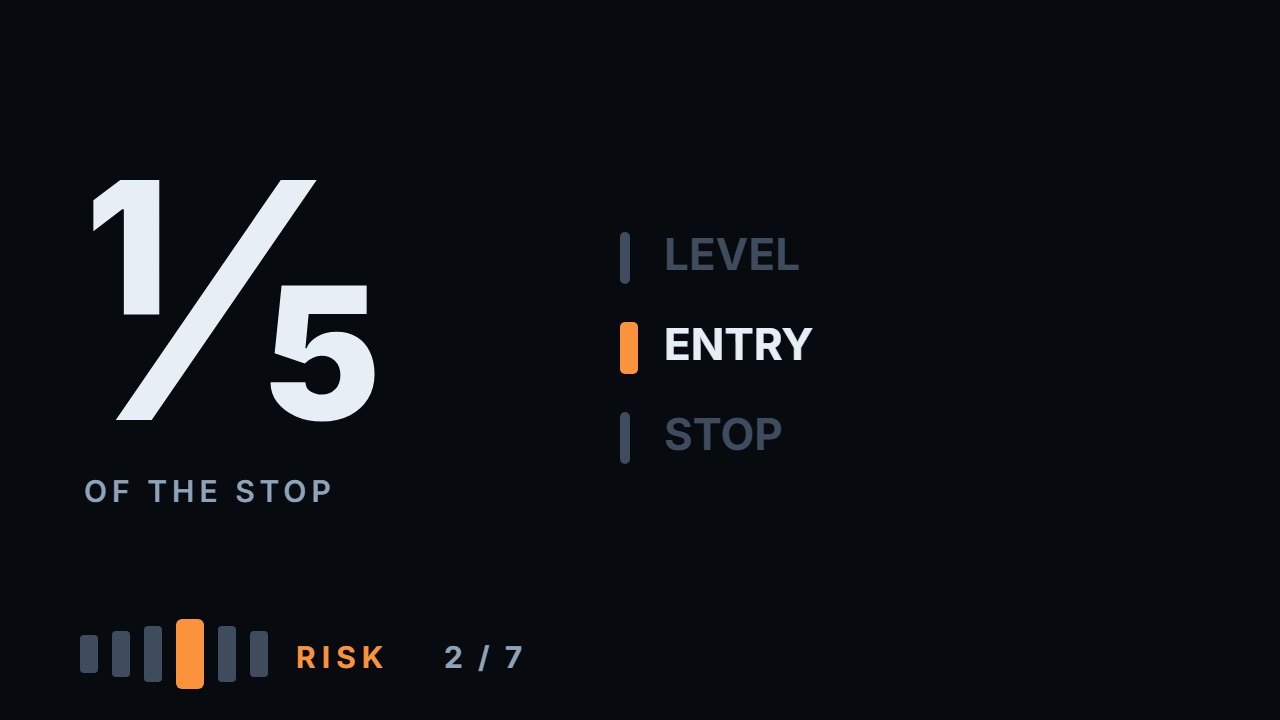
The buffer is a fraction of your stop distance. Roughly a fifth is a reasonable working figure. If your stop is fifty dollars wide, the buffer is around ten. If your stop is fifty cents wide, the buffer is around ten cents. That immediately raises the real question, which is where the stop distance comes from.
The stop distance comes from the instrument, not from your account. This was the previous video in this module, and here's the part of it that matters now: the stop belongs outside the range of movement that means nothing. Every instrument has that range, and it's measurable. It's a small slice of the distance the instrument travels in a day — and that distance is the average of the daily high-to-low over the last few weeks.
A workable stop sits at a small fraction of it. Somewhere around a tenth to a seventh, depending on how you trade. There's a second way to the same number: the size of an average five-minute bar. On liquid instruments the two land close together, and when they disagree, take the larger.
One caution, because this is less settled than it looks. There is more than one way to compute a daily range, and the common ones disagree — sometimes by a third. Which one your platform draws is a choice somebody made for you. That's its own video in the range module; whichever you pick, use one method consistently.
Numbers, so this stops being abstract. These are illustrative — you'll compute your own, and they change. Say Bitcoin's average daily range is two thousand dollars. A stop at a tenth of that is two hundred. A buffer at a fifth of the stop is forty. So your entry goes forty dollars inside the level, and your stop sits two hundred dollars past it, on the other side.
Say Apple's average daily range is four dollars. A stop at a tenth of that is forty cents. Round it to fifty. The buffer is ten cents. Same procedure, two markets, two completely different numbers. That's the point: the method transfers, the parameters never do.
There's a ceiling on all of this, and it's worth seeing before you go any further. Your stop has to be small relative to the daily range for the target to be reachable at all. If your stop is half of what the instrument travels in a day, then a target at three times your stop needs a move of one and a half daily ranges. That doesn't happen often enough to build on.
So the fraction isn't a style preference. A stop that's too wide doesn't just risk more — it quietly makes the target unreachable, and you end up with a system that takes full losses and partial wins.
Here's the whole sequence, in the order it has to happen. One: the level. Two: the stop distance, from the instrument's daily range. Three: the buffer, a fifth of the stop. Four: the entry, which is the level plus or minus the buffer. Five: the protective stop, a full stop distance past the level. Six: your risk, from the entry to that stop — and the target, a multiple of that risk, also from the entry.
The order isn't a preference and it can't be rearranged. You can't size the buffer before you know the stop, because the buffer is a fraction of it. And you can't size the trade before the entry, because the risk is measured from a price you haven't got yet.
Every number after the first comes out of the one before it. Nothing in that chain is chosen. That's the property worth having: when a trade goes wrong you can point at which number was wrong, instead of at yourself.
Now step six, which is where the money leaks. The stop stays where the idea is wrong, past the level. Your risk is measured from your entry. Say resistance is at a round number and you're selling. Your buffer puts your entry ten points below it. If you now place your stop one stop-distance above the level, your actual risk is one stop plus ten points — because you got in ten points lower than you were measuring from.
It's small on one trade. It's a consistent overrun on every trade, in the same direction, and it's invisible because the number in your head is right and only the arithmetic is wrong. Measure from the price you actually got.
A full one, short side. Resistance at forty thousand on Bitcoin. Daily range two thousand, so the stop is two hundred and the buffer is forty. You're selling, so the entry goes below the level: thirty nine thousand nine hundred and sixty, as a limit sell.
The protective stop is two hundred above the level — forty thousand two hundred. From your entry that's two hundred and forty, and two hundred and forty is your risk. Size from it, not from two hundred. The target at three times the risk is seven hundred and twenty below the entry: thirty nine thousand two hundred and forty.
The same thing on Apple, long side, so you can see nothing changes but the digits. Support at one hundred and eighty. Daily range four dollars, stop fifty cents, buffer ten cents. You're buying, so the entry goes above the level: one hundred and eighty dollars and ten cents.
Protective stop fifty cents below the level: one seventy nine fifty. That's sixty cents below your entry, and sixty cents is your risk. Target at three times that is a dollar eighty above the entry: one eighty one ninety. Two instruments, two price scales, one procedure.
Where this breaks, and there are four places. A buffer that's too large puts your entry inside the noise the level was supposed to keep you out of. You'll fill almost every time, and a good share of those will be trades the level never actually supported. A buffer that's too small doesn't fill, and you're back where you started with extra steps.
In a fast move it does nothing at all. Price goes through your level and your entry together. No distance fixes that, because the problem there isn't the queue.
And a fourth case that runs the other way. On a thin instrument the line of orders at any price is short, so you'd have filled at the level anyway — the buffer is pure cost with nothing bought. It solves a crowding problem. Where there's no crowd, the spread you're already paying is the number that deserves your attention.
One more thing about the numbers themselves, because I don't want to hand you a table you'll trust for too long. A tenth of the daily range, a fifth of the stop — those are working conventions, not laws. They're a place to start measuring from, not a place to stop.
What is a rule is the shape: the buffer comes out of the stop, the stop comes out of the instrument, and neither comes out of how much you'd like to make. Recompute both when the instrument changes and when its volatility changes. A number that was right in a quiet month is wrong in a loud one.
So, the thing to go and do, and it takes one evening. Pick one instrument. Measure its average daily range over the last twenty days — high minus low, averaged. Twenty, not five: a little less precise, but your stop won't jump every week. Take a tenth of that: that's your stop distance. Take a fifth of the stop: that's your buffer.
Now go back through your last ten entries on that instrument and mark, for each one, whether price traded through your entry price by at least the buffer. Count how many would have filled with the buffer and how many without. No trades yet? Take ten setups on that instrument from a chart six months back, and run the same count. Then look at which trades made up the difference. If they lean toward the good ones, as the mechanism says they should, that is the expensive kind of miss. Educational content only. Nothing here is financial advice.
Educational content only. Nothing in this video is financial advice, a recommendation to buy or sell, or a promise of any result. Trading involves risk of loss. Do your own research. Risk warning.