Where Experienced Traders Disagree
 Video coming soon on YouTube
Ask five experienced traders where the stop goes and you get five answers, delivered with complete confidence, at least two of them opposite. The usual explanation is temperament. This video tests a different one — maybe they disagree because the answer genuinely depends on the setup, right for a bounce and wrong for a breakout — and it is the last test this course runs.
Two events on the same levels: a bounce, where price arrives at a level and you trade away from it, and a breakout, where price closes beyond a level and you trade through it. Three decisions with the same options for both — stop at half, one, or one and a half daily ranges; exit on a target, on time, or on a trail; enter immediately or the next morning. 808 bounce signals, 687 breakout signals, six instruments. Entering the breakout immediately was excluded before anything was measured: it would have picked its good days afterwards.
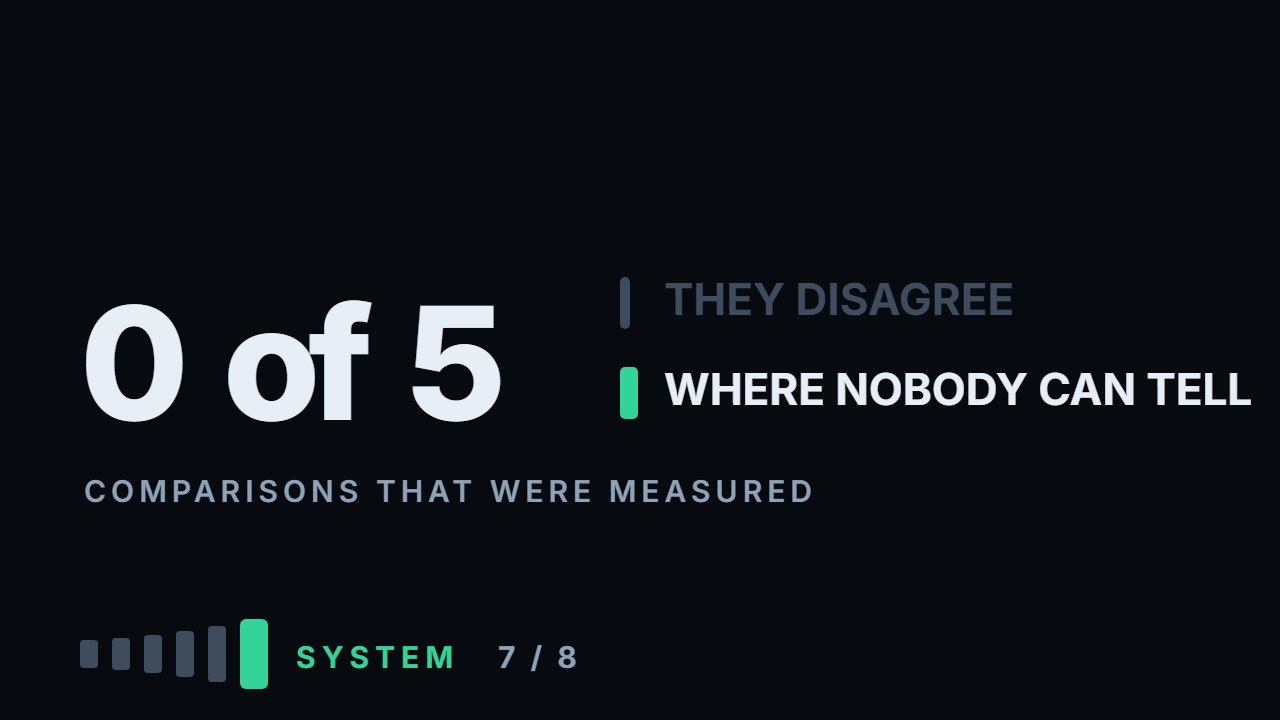
The good explanation fails at the first step. The stop: half a range is best on both events. The exit: a time exit on both. The entry: the next morning on both. Not one decision flips. And there is a deeper problem, which shows when the differences get measured rather than ranked — trade by trade, because the variants run on the same trades, so comparing two averages throws the pairing away. The stop on the bounce: 0.07R apart, error 0.05R, across 731 trades. The stop on the breakout: 0.04R, error 0.04R, across 667. The exit on the bounce: 0.12R, error 0.07R; on the breakout 0.03R, error 0.03R. The entry on the bounce: zero, error 0.06R. Five comparisons, and not one of them clears two error bars; the sixth could not exist.
So even the agreement in the first half is not a finding; it is the ranking of numbers that cannot be told apart. Which answers the title less comfortably: experienced traders disagree because at any number of trades a human accumulates, these decisions are indistinguishable. A trader with fifteen years and two thousand trades has a weaker sample than this one: his trades are spread across setups, each taken only one way. You cannot resolve it by finding the more experienced one. What you can do is ask which of them measured, on how many trades, and with what error bar. And the place where nobody argues is telling: both events rank the fixed target as the worst exit, found separately by the bounce and breakout videos — not a measurement, since both gaps sit between one and two error bars, but a hint worth keeping — and nobody argues about fixed targets. The arguments cluster exactly where the measurements cannot separate anything. All of this is before costs. Every variant pays one round trip, so costs cannot reorder the exits, but they charge a half-range stop about twice what they charge a full one.
What to do with this
This one is a habit rather than a task. The next time you hear confident advice about a stop, an entry or an exit, ask yourself a single question: how many trades would it take to know this? If the claim is about a tenth of an R, the answer is over three thousand, and almost nobody has that. It does not make the person dishonest — it makes the claim unfounded, and that applies to this channel exactly as much as to them. Not every video in this course puts an error bar on its comparisons; many of the earlier ones ranked numbers without one, and some of their findings would not clear two.
Chapters
- 0:00Five traders, five answers
- 0:19A different explanation
- 0:53Two events on the same levels
- 1:07Three decisions, the same options for both
- 1:29The variant that had to be thrown out
- 1:57Excluded in the calculation, not in a footnote
- 2:13The stop: the same answer
- 2:28The exit and the entry: the same again
- 2:47The tidy video I nearly made
- 3:07What measured actually means
- 3:29The stop, trade by trade
- 3:53The exit and the entry
- 4:14Five comparisons, not one clears
- 4:37A better answer, and a less comfortable one
- 4:55Indistinguishable, on fifteen hundred trades
- 5:08Fifteen years of experience is a coin
- 5:57You cannot resolve it by finding the more experienced one
- 6:16What to do when two people you respect disagree
- 6:32Which rule can I follow without arguing with myself
- 6:57Where the arguments live
- 7:31Nobody argues about fixed targets
- 7:42Three limits
- 8:27Go and do this
- 8:53It applies to me exactly as much as to them
The calculation
Every number this lesson says out loud comes from the script below. results.txt is what it printed when the video was made.
Full transcript
Ask five experienced traders where the stop goes and you will get five answers, delivered with complete confidence, and at least two of them opposite.
The usual explanation is temperament. Some people are patient, some are not, and each found what suits them.
This video tests a different explanation, and the test is the last one this course will run. By the end you'll be able to ask the one question that settles most trading advice: how many trades would it take to know this.
Here is the idea. Maybe they disagree because the answer genuinely depends on the setup — right for a bounce, wrong for a breakout.
That would be a good explanation. It is testable, and it turns out to be wrong in an interesting way.
Two events on the same levels. A bounce: price arrives at a level and you trade away from it. A breakout: price closes beyond a level and you trade through it.
Three decisions, the same options for both. Stop at half, one, or one and a half daily ranges. Exit on a target, on time, or on a trail. Enter immediately or the next morning.
Eight hundred and eight bounce signals, six hundred and eighty seven breakout signals, six instruments.
One variant had to be thrown out before anything was measured, and it is worth thirty seconds.
For the breakout, entering immediately means an order resting at the level. But the signal is the first CLOSE beyond the level, and that is only known at the end of the day.
So a resting order would also have filled on all the days price touched the level and fell back — days that never entered this sample.
That variant would have picked its good days afterwards. It is excluded, and the exclusion is in the calculation, not in a footnote.
Now the results, and the first surprise is that the good explanation does not even get started.
The stop. On the bounce, half a range is best. On the breakout, half a range as well.
The same answer to the same question, from the same six instruments, over the same window.
The exit. On the bounce, a time exit is best. On the breakout, a time exit as well. And the entry: the next morning, on both.
Not one of the three decisions changes its answer between the two events. The tidy explanation fails at the first step.
It would have been a satisfying story: experienced traders disagree because they trade different setups, and each is right about their own.
But there is a deeper problem than the missing split, and it shows up when you do the thing this channel does: ask whether these differences are measured at all.
Not "is one number bigger than the other". Bigger is easy. A difference counts as measured only when it is at least two error bars away from zero.
And because the variants run on the same trades, the comparison has to be done trade by trade, not by comparing two averages.
The stop, on the bounce. The clearest pair differs by zero point zero seven of an R, with an error of zero point zero five, across seven hundred and thirty one trades.
The stop, on the breakout. Zero point zero four, error zero point zero four, across six hundred and sixty seven.
The exit, on the bounce: zero point one two, error zero point zero seven. On the breakout: zero point zero three, error zero point zero three.
The entry, on the bounce: nothing at all — zero, error zero point zero six.
Five comparisons, and a sixth that could not exist. Not one of the five clears two error bars. The closest is the exit on the bounce, at one point nine. Not one.
So even the agreement in the first half of this video is not a finding. It is the ranking of numbers that cannot be told apart.
Which gives a better answer to the question this video is named after, and a much less comfortable one.
Experienced traders disagree about these decisions because, at any number of trades a human being accumulates, these decisions are indistinguishable.
Not "hard to distinguish". Indistinguishable, on almost fifteen hundred trades split across two events and six instruments.
Think about what that means for the people giving the advice.
A trader with fifteen years and two thousand trades has, for any one of these decisions, a weaker sample than this video. His trades are spread across setups, and each was taken only one way, on one instrument rather than six.
At that size the ranking of stop distances is a coin. Their experience produced an answer, honestly and sincerely, and the answer was random.
Another trader, equally honest, got the opposite coin. Both remember the trades that confirmed it, because everyone does.
So the disagreement is not a clash of wisdom. It is what randomness looks like when it passes through two confident people.
And this is the part that matters: you cannot resolve it by finding the more experienced one.
More experience means a slightly bigger sample of something that needs three thousand trades before a tenth of an R even shows. It does not cross the gap.
Which also tells you what to do when two people you respect contradict each other.
Ask which of them measured, on how many trades, and with what error bar. Usually neither, and then the disagreement carries no information at all.
And if the honest answer is that nobody knows, then the decision is yours to make on other grounds.
On grounds like: which rule can I follow without arguing with myself at the moment of entry.
That is not a consolation prize. In the trading-plan video the argument came from the other side: a written rule you follow is the only thing that makes your record readable.
There is one more thing in this data, and it shows where the arguments live.
The two events agree on everything here, and on one thing they agree loudly. The fixed target is the worst exit on both, and the bounce video and the breakout video found that separately.
That is not measured either: both gaps sit between one and two error bars. Two events pointing the same way is a hint, not a finding.
And you will notice that nobody argues very much about fixed targets. The arguments cluster exactly where the measurements cannot separate anything.
Three limits. One: three decisions, two or three options each. A decision with a genuinely large effect would have shown up here, and none did.
Two: about fifteen hundred trades, one window, six instruments. A larger sample would separate smaller differences — that is the whole point, and neither you nor I have one.
Three: all of this is before costs. Every variant pays one round trip, so costs cannot reorder the exits. But they charge a half-range stop about twice what they charge a full one, and on the breakout that can eat most of its lead.
So, what to go and do. It takes ten minutes, and it is a habit rather than a task.
The next time you hear confident advice about a stop, an entry or an exit, ask yourself one question: how many trades would it take to know this?
If the claim is about a tenth of an R, the answer is three thousand, and almost nobody has that.
That does not make the person dishonest. It makes the claim unfounded, which is different, and it applies to me exactly as much as to them.
Not every video in this course puts an error bar on its comparisons. Many of the earlier ones ranked numbers without one, and some of their findings would not clear two.
Which is what this whole course has been teaching: the useful question is never "who is right". It is "what would it take to find out", and sometimes the answer is more than anyone has.
Five comparisons on fifteen hundred trades, not one of them measurable. That is where experienced traders disagree, and now you know why. Educational content only. Nothing here is financial advice.
Educational content only. Nothing in this video is financial advice, a recommendation to buy or sell, or a promise of any result. Trading involves risk of loss. Do your own research. Risk warning.