When Not to Trade
 Video coming soon on YouTube
Not taking a trade is a decision too, and it can be measured. This video takes the 818 trades from the crypto-versus-stocks video — an untested level touched from the right side, entry at the level, a stop half a daily range beyond it, a target two stops away, out after ten days — and three reasons this course has already given for skipping one. The setup itself loses on all six instruments: −0.18R a trade before costs, −0.26R after.
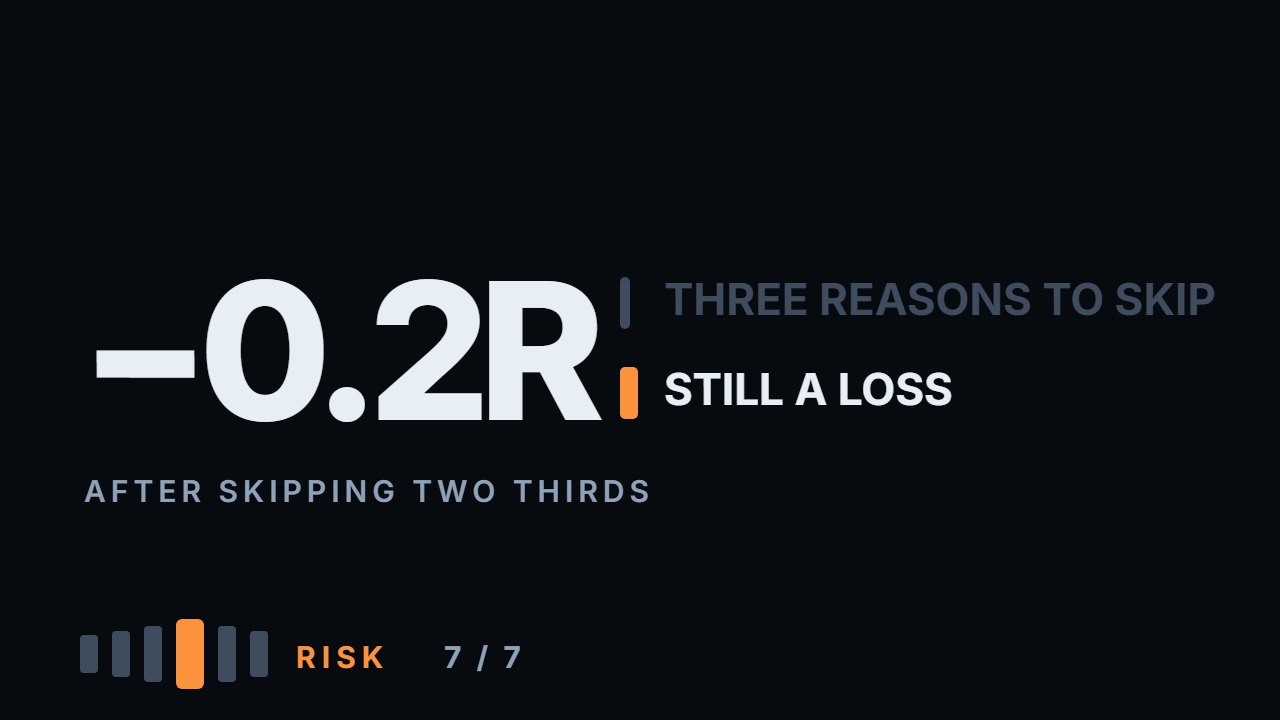
Refusal one, no room: the next level, a turn with five bars on either side known before the day of the touch, sits closer than the target. It skips 342 trades, 42%. Kept −0.16R, skipped −0.21R: a difference of 0.05 with an error of 0.09, half an error bar, pointing the same way on both halves of the window and noise on both. Refusal two, the open is past the line: 49 trades, stocks only, a difference of 0.09 with an error of 0.19, and it flips between the halves. Refusal three, a round trip that costs more than a tenth of an R: 304 trades, mostly on the index fund and Bitcoin. Before costs the skipped trades did exactly as well as the kept ones, −0.17 against −0.18; after costs they are worse by 0.07R, and that difference is known before the trade — the skipped trades pay 0.13R a round trip, the kept ones 0.06R. All three together skip 535 trades, and the 283 that remain still lose 0.2R a trade after costs, two and a half error bars below zero.
So refusing did not rescue the setup, and the useful part is the split. Some refusals are arithmetic and certain before the trade: the cost in R, and the size — at 1% risk and a stop of half a range, every one of the 115 index fund trades needed a position two and a half times the account. Others are predictions — no room, a gap, a chart that does not look right — and a prediction needs a measurement that 818 trades could not provide. Everything here is measured: the calculation ships with the video.
What to do with this
Keep a second log next to your journal: every setup you skip, with the date, the instrument and the reason in a word or two — and then what happened, exactly as if you had taken it. After fifty skips, compare skipped against kept with an error bar. Refuse on arithmetic always; refuse on a prediction only once your own record has measured it.
Chapters
- 0:00Not taking a trade is a decision too
- 0:26The 818 trades, and what they lost
- 1:01Refusal one: no room
- 1:49What no room is worth
- 2:31Refusal two: the open is past the line
- 3:35Refusal three: the cost
- 4:27All three together
- 4:58Arithmetic and predictions
- 6:08The rule this video is for
- 6:26Three limits
- 6:58Go and do this
The calculation
Every number this lesson says out loud comes from the script below. results.txt is what it printed when the video was made.
Full transcript
Not taking a trade is a decision too, and it can be measured like any other.
This video takes the eight hundred and eighteen trades from the crypto-versus-stocks video, and three reasons this course has already given for skipping one.
By the end you'll be able to sort any reason to skip a trade into two kinds: the ones you can calculate before the trade, and the ones you would have to measure first.
The trades first. An untested level, touched from the right side within three daily ranges. Entry at the level, a stop half a range beyond it, a target two stops away, and out after ten days.
On six instruments they lost: minus zero point one eight of an R a trade before costs, minus zero point two six after.
So the question is not whether skipping makes this setup profitable. It is whether the skipped trades were any worse than the ones that were kept.
Refusal one, from the room video: the next level sits between you and the target. Here the target is two stops away, one daily range from the entry.
The level is a turn with five bars on either side, known before the day of the touch. If it is closer than the target, the trade is skipped.
Here is the latest Apple trade it skipped. A buy from two eighty seven thirty eight in June, with the target at two ninety three oh six.
The nearest turn above sat at two eighty eight sixty two, a turn from December, about a fifth of a daily range from the entry, with the whole target behind it. That trade was stopped out the same day.
Across all of them, the rule skips three hundred and forty two of the eight hundred and eighteen trades. Forty two per cent.
The kept trades made minus zero point one six. The skipped ones, minus zero point two one. A difference of zero point zero five.
Its error is zero point zero nine, so the difference is half an error bar. A difference counts as measured on this channel at two.
On the two halves of the window it points the same way both times, and both times it is noise. A direction, not a measurement.
Refusal two, from the stop-placement video: the day of the touch opened beyond the level. A gap through the line your order is waiting on.
Apple in May, at that same December turn: a sell order at two eighty eight sixty two, and the day opened at two eighty nine twenty seven, already past it. That trade was stopped out the same day too.
It only happens on stocks. The coins trade through the night, so there is no open to gap. Forty nine trades in all.
Kept, minus zero point one seven. Skipped, minus zero point two seven. A difference of zero point zero nine, with an error of zero point one nine.
And on the two halves it flips: the skipped trades were worse on one and better on the other. Forty nine trades cannot tell this rule from a coin.
Refusal three, from the crypto-versus-stocks video: the round trip costs more than a tenth of an R.
It skips three hundred and four trades, most of them on the index fund and on Bitcoin, where the stop is narrow against the fee.
Before costs, the skipped trades did exactly as well as the kept ones: minus zero point one seven against minus zero point one eight.
After costs they are worse, and that part is not a measurement. The skipped trades pay zero point one three of an R a round trip, the kept ones zero point zero six.
The difference, zero point zero seven, is known before a single trade is placed. It has no error bar, because nothing in it is a guess.
Now all three together. They skip five hundred and thirty five trades, almost two thirds.
The two hundred and eighty three that remain lose zero point two R per trade after costs. That is two and a half error bars below zero.
So refusing did not rescue the setup. The kept trades lose, and the skipped ones lose a little more, by an amount this sample cannot separate from chance.
And that split is the useful part, because the three refusals are not the same kind of thing.
The cost is arithmetic. You know it before the trade: the fee divided by the stop. A refusal on it is certain.
So is the size. At one per cent of the account and a stop of half a range, the position on the index fund is two and a half times the account.
All one hundred and fifteen of the index fund trades needed borrowed money. Ninety two of Apple's one hundred and eight did.
That limit is from the position-size video, and it is arithmetic too: if the position is bigger than the account, you either size down or you are trading on borrowed money.
The other two are predictions. No room and a gap through the line are claims that the trade will be worse, and a claim about the future needs a measurement.
On eight hundred and eighteen trades, the measurement could not tell them from chance. That does not make them wrong. It means this many trades cannot show it.
Which gives the rule this video is for. Refuse on arithmetic, always. Refuse on a prediction only once you have measured it on your own trades.
And the most common reason to skip a trade, that it does not look right, is a prediction too.
Three limits. One: daily bars. The room is measured from turns known at yesterday's close, and a level an intraday trader sees would change it.
Two: the costs are the channel's model, five hundredths of a per cent a round trip on a stock and two tenths on crypto.
Three: one setup, and a losing one. A refusal could matter more on a setup with an edge, and that is exactly what your own record would have to show.
So, what to go and do. It starts with the next setup you see, and it costs nothing.
Keep a second log next to your journal: every setup you skip. The date, the instrument, and the reason, in a word or two.
Then what happened, exactly as if you had taken it: the entry, the stop, the target, and the result in R. No trades yet? This log needs none.
After fifty skips you can do what this video did: skipped against kept, with an error bar. Until then, a reason to skip is a guess.
Arithmetic first, predictions measured. Educational content only. Nothing here is financial advice.
Educational content only. Nothing in this video is financial advice, a recommendation to buy or sell, or a promise of any result. Trading involves risk of loss. Do your own research. Risk warning.