Why You Trade Worse When You Need the Money
 Video coming soon on YouTube
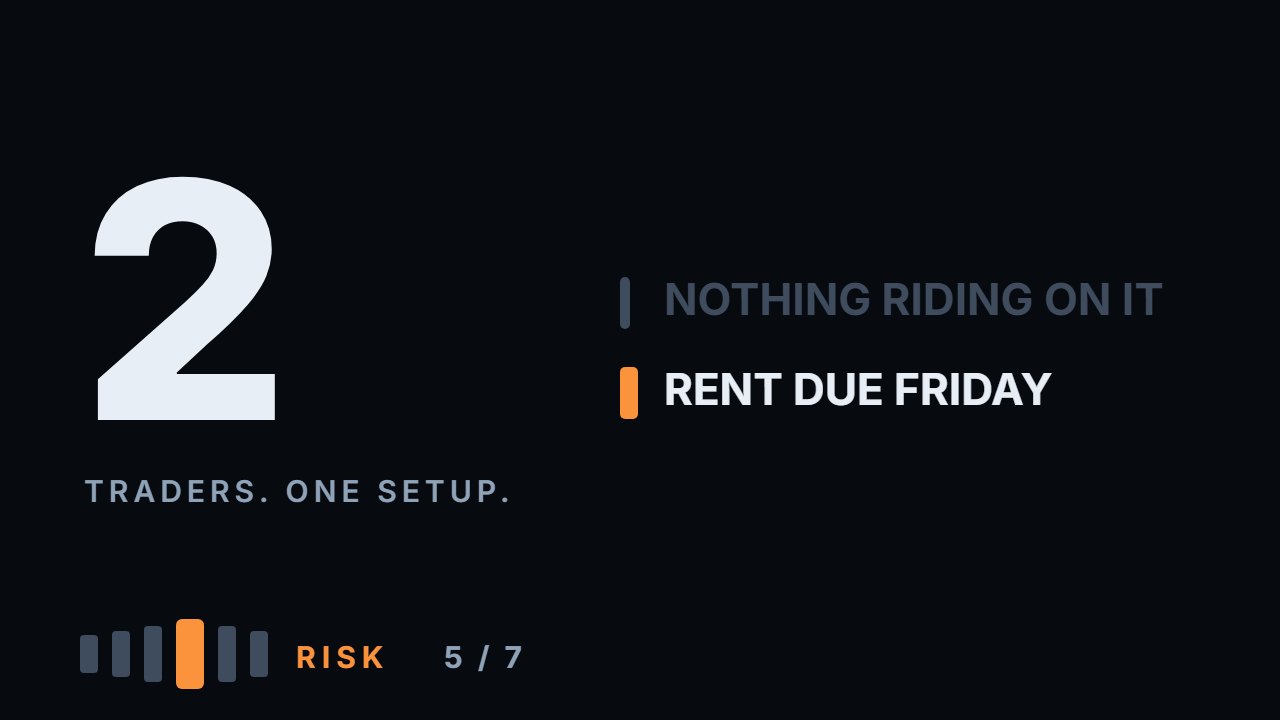
Two traders take the same setup — same instrument, same level, same stop. One has nothing riding on it. The other needs rent by Friday.
They will not get the same result, and the reason is not discipline. It is that they are solving two different problems, and only one of them has a deadline attached.
What to do with this
Mark the months in your trade log where you needed the money. Then compute four numbers for those months and for the others: number of trades, average size, average win, average loss. If the needed months show more trades, bigger size, smaller wins and larger losses, you have found the mechanism in your own record.
Chapters
- 0:00One setup, two traders
- 0:59Money is coined freedom
- 1:36Mechanism one: a different problem
- 2:36Why high variance is correct
- 2:57Correctly solving the wrong problem
- 3:40Mechanism two: missed trades hurt
- 4:20Mechanism three: shorter holds
- 4:57Mechanism four: the stop moves
- 5:31All four stacked
- 6:15The timing problem
- 6:47Why willpower does not fix it
- 7:34Three ways to change the problem
- 8:26The fix that is not one
- 8:48The limit of this
- 9:47Go and do this
Full transcript
Rent is due on Friday. Picture one setup taken twice: same instrument, same level, same entry, same stop, same target. On paper it is one trade, executed twice. One trader has nothing riding on it. The other needs rent by Friday. They will not get the same result, and the reason is not that one has better discipline. It's that they are not actually doing the same thing.
By the end of this you'll have a mechanism, not a lecture about psychology. Four specific ways that needing the money changes what you do — each one measurable, each one individually reasonable, and all four pushing the same direction. And the fix isn't willpower. It's structural, and it's uncomfortable.
Start with the sentence that names it, and it isn't from a trading book. "Money is coined freedom," Dostoevsky wrote, in a book about a prison camp. And he finished the thought: which is why, to a man deprived of freedom entirely, it is worth ten times more.
He was writing about convicts. But the second half is the part traders should sit with. Money is not worth the same to you at all times. It's worth more when you need it — and everything you do with it changes accordingly.
Mechanism one, and it's the big one, because it's arithmetic rather than emotion. A trader with nothing riding on the outcome is solving one problem: maximise expectancy. Take the trades with positive edge, size them consistently, let the average do the work.
A trader who needs five thousand dollars by the end of the month is solving a different problem: maximise the probability of reaching five thousand by a date. Those are different questions. They have different answers.
And here's the thing that makes it dangerous instead of merely unfortunate. When you need to reach a target by a deadline, and your current position is short of it, the strategy that maximises your chance of getting there is one with more variance in it — results that swing wider both ways. Bigger size. More trades. More risk per trade.
That is not a mistake. Given the problem as stated, it is correct. Higher variance genuinely does raise the odds of covering a gap in limited time. It doesn't improve your edge at all, and past a certain size the swings alone will empty the account, even with an edge.
So put that plainly, because it inverts how this usually gets discussed. The trader who needs the money is not failing to follow the system. He is correctly solving the wrong problem.
That is why "just be disciplined" doesn't work as advice. You are not asking him to stop being sloppy. You are asking him to keep optimising for the long run while his actual constraint is a date three weeks away. Nobody does that. It isn't a character flaw — it's that the two objectives genuinely conflict, and only one of them has a deadline attached.
Mechanism two: need changes which mistakes feel expensive. With nothing riding on it, a missed trade costs nothing. You didn't lose anything. There will be another one.
When you need the money, a missed trade feels like a loss — because the gap to your number didn't close, and a day went by. So marginal setups start looking acceptable, not because your standards dropped on purpose, but because the cost of waiting went up. If the mechanism is there, it shows up in the count: more trades in the months you needed the money.
Mechanism three: need shortens the hold. Unrealised profit is not money. You can't pay anything with it. When you need money, the position that is up two hundred dollars is two hundred dollars that exists only if you take it now, and every minute you hold it, it might not.
So you take it. Reasonably. Prudently, even. And that cuts your average win — which, if you watched the win-rate video, is one of exactly two numbers that decide whether the whole thing makes money.
Mechanism four: need makes a loss unaffordable, so the stop moves. If losing three hundred dollars means the number gets further away, the stop stops being the price where your idea is wrong and becomes a price you are negotiating with. You give it room. It's still a valid trade, you tell yourself, and sometimes it is.
That's the stop-placement video, arriving from a different direction: a stop moved for a reason that has nothing to do with the market.
Now stack all four, because separately they're survivable and together they're not. More trades, of lower quality. Bigger size on each. Winners cut shorter. Losers allowed to run further.
Run those four through the expectancy line from the win-rate video and you don't get a slightly worse system. You get the sign flipped. Average win down, average loss up, weaker setups on top — and the win rate may even rise, which is exactly why it feels fine. None of it required a single decision you'd call reckless at the time.
Which brings the honest and unpleasant timing problem. The moment a person most wants trading to work is the moment they are least able to do it well. Financial pressure is usually what brings someone to it in the first place.
So the typical starting condition is the one that guarantees the worst version of the four mechanisms above. Not because beginners are undisciplined. Because the pressure that made them start is the same pressure that degrades execution.
So what actually fixes it. It isn't willpower, and I want to be specific about why. Willpower operates on the second, third and fourth mechanisms — you can, with effort, decline a marginal trade or hold a winner. It does not touch the first one, because the first one isn't a behaviour. It's the goal itself — the thing you're trying to maximise. As long as you need a number by a date, the mathematically correct action is high variance, and every hour you spend resisting it is an hour spent fighting your own arithmetic. The only real fix is to change the problem.
Three ways to change it, in order of how well they work. One: separate the account from your life. Income comes from somewhere else. The trading account has no deadline and no required withdrawal. This is the only complete fix, and it's the one nobody wants to hear, because it means the thing you hoped would pay you can't pay you yet.
Two: reduce size until the outcome genuinely doesn't matter. If the result of this month is invisible in your life, the deadline problem disappears. Small enough is a real strategy, not a consolation prize. Three: stop, for now. A pause costs you nothing except trades you would have executed badly.
And one thing that looks like a fix and isn't: setting a bigger target so you need fewer trades. That's the same extra variance wearing a plan. It doesn't remove the deadline, it just concentrates it into larger bets, which is precisely what the first mechanism was already pushing you toward.
Now the limit of this, because I don't want to overstate it. None of this says a person under pressure cannot trade well. Some do. What it says is that the same person, with the same skill, tends to execute worse when the outcome is needed — and that this is predictable rather than random.
It also isn't a claim about how you feel. You may feel completely calm and still take more trades, cut winners sooner and give losers room. The mechanisms don't run on emotion. They run on the objective.
Which is why the check is a count, not an introspection. You will not detect this by asking yourself whether you were feeling pressured. You'll detect it by comparing numbers between periods, because the behaviour shows up in the record even when it never showed up in the mood.
So, the thing to go and do, and it needs no new trades. Look at your trade log and mark the months where you needed the money: a bad quarter, a bill, a plan that depended on it. Then compute four things for those months and for the others. Number of trades. Average size. Average win. Average loss. No trades yet? Start your log with one extra column — whether you needed the money that month — so this check is possible later.
If the needed months show more trades, bigger size, smaller wins and larger losses, you've found the mechanism operating in your own record. Not as a feeling you can dispute. As four numbers. And if that pattern is there, the useful question isn't how to be more disciplined next time. It's what would have to be true for the next bad month not to be a month where you need it. Educational content only. Nothing here is financial advice.
Educational content only. Nothing in this video is financial advice, a recommendation to buy or sell, or a promise of any result. Trading involves risk of loss. Do your own research. Risk warning.